
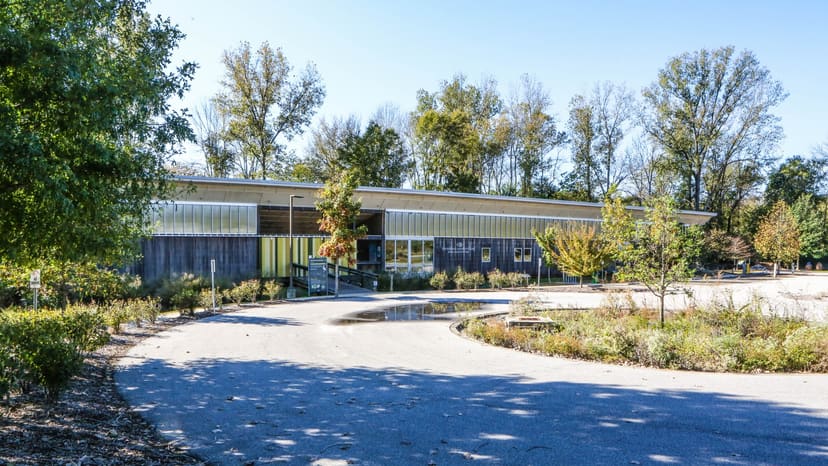
Wetland park and nature center
Walnut Creek Wetland Park
What people say
Walnut Creek Wetland Park is a free urban nature center and wetland at the meeting of Walnut Creek and Little Rock Creek greenways, offering accessible indoor facilities, animal ambassadors, crafts and a library, extensive loaner exploration gear, two short flood-prone nature trails, public art, and environmental history rooted in Southeast Raleigh communities.
At this place
Upcoming events
Inside this place
Explore the grounds
Choose a destination, preview what it looks like, then open Explorer for live on-site guidance.
Public record
Verified information
What people ask
Useful answers about this place
Frequently requested details, researched and kept current by AuditMap.
Where should I park at Walnut Creek Wetland Park?
Navigate to 950 Peterson Street and use the Education Center parking areas, which include electric-vehicle charging. This is the best starting point for restrooms, water fountains, staff, maps, loaner gear, animal ambassadors, Ross Andrew's Loop, and the Walnut Creek and Little Rock Creek greenways.
Where should I start at Walnut Creek Wetland Park?
Begin in the lobby of the Norman and Betty Camp Education Center at 950 Peterson Street during open hours. Staff can explain current trail flooding, provide maps and scavenger hunts, introduce the animal ambassadors, and check out gear. Beaver Crossing also has neighborhood approaches from Bailey Drive and a steep staircase from South State Street.
Are there restrooms at Walnut Creek Wetland Park?
Yes. Public restrooms and drinking-water fountains are inside the ADA-accessible Education Center. Their availability follows the Center's Tuesday-Sunday operating schedule, so do not assume indoor facilities are available on Monday or after the building closes.
What hours is Walnut Creek Wetland Park open?
The Education Center opens at 10 a.m. Tuesday-Saturday and 1 p.m. Sunday and is closed Monday. Closing follows dusk: 5:30 p.m. January; 6 February; 6/7 March; 7:30 April; 8 May; 8:30 June-July; 8 August; 7:30 September; 6:30 October; and 5 p.m. November-December.
Is Walnut Creek Wetland Park free?
Yes. Education Center admission, lobby exhibits, animal ambassadors, library, craft table, scavenger hunts, trails, greenway access, and available exploration gear are free. Public and private programs, classroom rentals, and birthday-party packages may charge and require advance booking.
Is Walnut Creek Wetland Park wheelchair accessible?
The Education Center is ADA accessible and provides restrooms, fountains, classrooms, deck seating, and accessible leisure areas. Natural wetland routes are less predictable: Ross Andrew's Loop mixes natural and mulch surfaces, and Beaver Crossing is mostly unmaintained natural surface with elevated footpaths and a steep staircase at its South State Street end.
What trails are at Walnut Creek Wetland Park?
Ross Andrew's Loop is about 0.21 mile with natural and mulched surfaces, a creek overlook spur, coverboards, and frog pipes. Beaver Crossing Gateway Trail is about 0.26 mile, mostly unmaintained natural surface with two small elevated footpaths. Both are wetland trails rather than dry all-weather sidewalks.
Do Walnut Creek Wetland Park trails flood after rain?
Yes. Both nature trails occupy active wetland areas and may flood after large rain events; Beaver Crossing floods frequently. Ask front-desk staff about same-day conditions, borrow boots when available, and never enter moving or unexpectedly deep water. The paved greenway may provide a better alternative when nature paths are inundated.
How does Walnut Creek Wetland Park connect to Raleigh's greenways?
The Center sits where Little Rock Creek Trail meets Walnut Creek Greenway, roughly halfway along the 15.6-mile Walnut Creek route between Lake Johnson and the Neuse River Trail. Cyclists can stop for restrooms during Center hours and use the onsite repair station to adjust or inflate tires.
Can I ride a bicycle on the wetland trails?
No. Bicycles and skateboards are limited to the paved greenway system through the park. Ross Andrew's Loop and Beaver Crossing are walking nature trails with wet, narrow, and sensitive surfaces. Use the bike repair station near the Center, then remain on the greenway with wheels.
Are dogs allowed at Walnut Creek Wetland Park?
Yes, but they must remain leashed, controlled, and on designated routes. Pick up waste; extra bags are available at the Nature Center front desk. Wetland wildlife, vegetation, ticks, copperheads, and narrow paths make off-leash exploration unsafe and disruptive.
What can I borrow at Walnut Creek Wetland Park?
During Center hours, front-desk staff can lend dip nets, rain boots or waders in multiple sizes, catch basins, field guides, binoculars, ecoExplorer Backpacks, trail maps, and sensory bags. Availability varies, so call ahead for groups larger than six or when a specific size or accommodation is essential.
What can children do at Walnut Creek Wetland Park?
Children can meet an Eastern kingsnake, black rat snake, eastern box turtle, and Cope's gray treefrog; make a monthly craft; use the free library and story area; follow a scavenger hunt or audio tree trail; read the oversized Norman Builds a Park installation; and borrow gear for supervised creek exploration.
What public art is at Walnut Creek Wetland Park?
The park includes Derrick Beasley's Stormwater Monolith near the food forest, Tiffany Baker's Bailey Drive Gateway Plaza installation honoring Rochester Heights residents, and Deborah Aschheim's Raleigh Stories portraits inside the Center's rental spaces. Indoor works are viewable when rooms are not rented.
Quick community check
Help verify this place
Know this place? Check one detail from a recent visit.
✓ Accurate × Incorrect ? Unsure
Community for this place
What people are noticing
Ask a question, share what changed, or help make a detail more reliable.
The place logUseful questions, updates, and confirmations from this community.
Keep exploring
Nearby public places
Based on this place's location and public details, not your activity.